🧠 The AI Agent Lifecycle: Harrison Chase’s ADLC — A Didactic Guide
A step-by-step introduction to building agents that actually work in production
🎯 What’s This All About?
If you’ve heard about AI agents (programs that use an LLM to decide what to do, call tools, and execute tasks autonomously), you’ve probably seen impressive demos. But how do you take an agent from «look what I built in my notebook» to something that runs 24/7 without breaking?
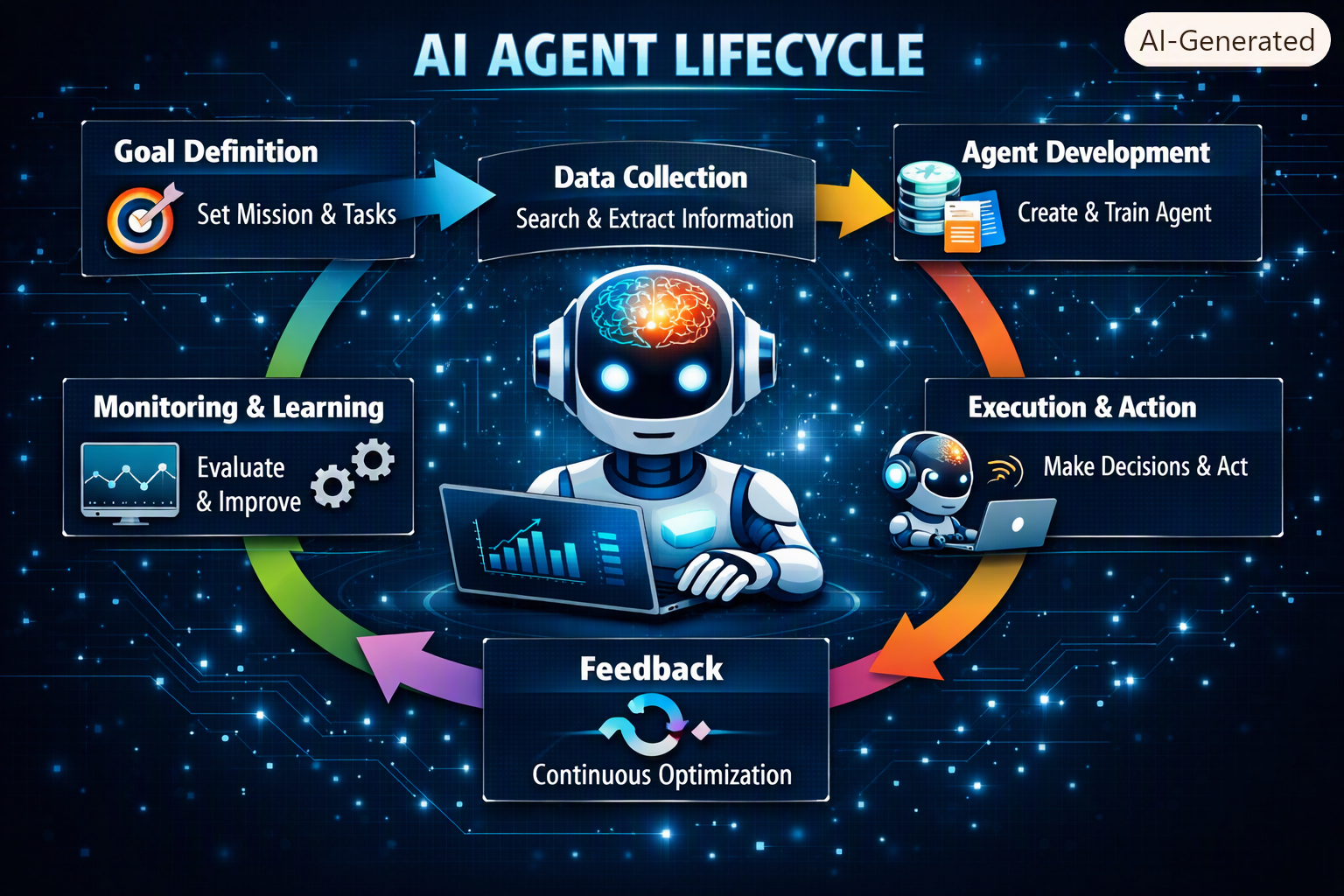
Harrison Chase (CEO of LangChain) offers a clear answer: the Agent Development Lifecycle (ADLC) — a 4-phase cycle that turns agent development from a dark art into repeatable engineering.
«Everyone wants to ship agents. The best organizations have figured out how to do it repeatedly and safely.» — Harrison Chase
🔄 The Cycle in a Mental Picture
Imagine building an agent is like cooking a new dish for a restaurant:
RECIPE → TEST KITCHEN → SERVE → COLLECT FEEDBACK
 (Build)    (Test)      (Deploy)   (Monitor)
     ↑                                   │
     └───────────────────────────────────┘
Each phase feeds into the next, and monitoring loops back to building. It’s a virtuous circle, not a straight line.
🧱 Phase 1: BUILD
This is more than writing code. You decide what level of abstraction to work at. Chase identifies 4 layers:
📦 1. Frameworks — The «Lego® Layer»
Libraries that help you compose pieces: LLM calls, tools, prompts, retrieval, agent loops.
- Examples: LangChain, CrewAI
- Analogy: Like having pre-made pieces and instructions. You don’t reinvent the wheel.
⚙️ 2. Runtimes — The «Execution Engine»
When your agent needs to remember things, pause, wait for a human, or loop, you need a runtime.
- Examples: LangGraph
- Analogy: The operating system of your agent. Without it, your agent has no memory and can’t handle interruptions.
🎣 3. Harnesses — The «Flight Harness»
A structured pattern that tells the agent when to stop, how to reflect, and how to resume.
- Examples: Deep Agents
- Analogy: Like safety instructions on a plane. The agent knows what to do in every situation.
🖱️ 4. No-code / Low-code — For the Rest of the Team
Lets non-technical people build agents visually.
- Examples: LangSmith Fleet
- Analogy: Like Canva for agents. You don’t know code, but you can still design.
💡 Golden rule: You don’t always need the most complex layer. Start simple (framework) and scale up (runtime → harness) only when your agent needs it.
🧪 Phase 2: TEST
This is the most important phase — and the one most people skip.
❓ What Tests to Run?
| Test Type | What It Measures | Example |
|---|---|---|
| Accuracy Eval | Does the agent give the right answer? | «What’s the capital of France?» → Paris ✅ |
| Tool Use Eval | Did it use the right tool? | Called get_weather() when asked about the weather ☀️ |
| Adherence Eval | Did it follow instructions? | Didn’t improvise outside its role |
| Safety Eval | Did it hallucinate or get vulnerable? | Didn’t execute dangerous commands |
🔬 How to Do It in Practice
- Create a test dataset (questions + expected answers).
- Run the agent against that dataset.
- Compare results using metrics (exact match, LLM-as-judge, etc.).
- Iterate: if it fails, tweak the prompt, tools, or model.
Analogy: Like a chef tasting a sauce 20 times before putting it on the menu.
🚀 Phase 3: DEPLOY
Your agent leaves your computer and starts serving real users.
🧭 Gradual Rollout
Local prototype → Staging → Canary (10% users) → 100% production⚠️ Critical Aspects
- Cost control: Each LLM call costs money. A poorly designed agent can bankrupt you.
- Tool governance: The agent should only access the tools it needs.
- Human-in-the-loop: Decide when the agent must ask a human before acting.
Analogy: You don’t open a restaurant with full service on day one. First, you do a soft opening with a few customers.
👁️ Phase 4: MONITOR
Once in production, the agent generates valuable data that you must leverage.
📊 What to Monitor
- Success rate — Did it complete the task?
- Latency — Did it respond quickly?
- Cost per call — Did it spike?
- Human interventions — Did the agent ask for help too often?
- Behavior drift — Did it start responding differently?
🔄 Closing the Loop
What you learn in Monitor feeds back into Build:
Monitor detects: "The agent fails when asked questions in Spanish"
      ↓
Build: Adjust the prompt to handle Spanish better
      ↓
Test: Validate with Spanish examples
      ↓
Deploy: New version
      ↓
Monitor: Verify it improved
🧩 The Continuous Learning Model (3 Layers)
Chase added this refinement at his Interrupt 26 keynote: when monitoring tells you to improve, you can act on 3 levels:
| Layer | What You Change | Example |
|---|---|---|
| Model | The base model | Switch from GPT-4 to Claude 4 |
| Harness | The execution pattern | Add a «reflection» step before responding |
| Context | The available information | Give it more historical examples or new tools |
Always start with Context (cheapest), then Harness, and only change the Model if necessary.
🧭 ADLC vs. Traditional MLOps — What’s Different?
| Aspect | Classic MLOps | ADLC (Agents) |
|---|---|---|
| Unit | Static model | Agent with state and tools |
| Main risk | Data drift | Emergent behavior |
| Testing | Accuracy on test set | Tool use, adherence, safety evals |
| Monitoring | Model metrics | Trace inspection, costs, interventions |
| Iteration | Re-train | Adjust prompt / context / harness |
🏁 Visual Summary
BUILD                  TEST                   DEPLOY                 MONITOR
 ┌──────────┐         ┌──────────┐          ┌──────────┐           ┌──────────┐
 │ Frameworks│        │  Evals   │          │ Gradual  │           │  Traces   │
 │ Runtimes  │  ──►   │ Dataset  │   ──►    │ Canary   │   ──►     │ Costs     │
 │ Harnesses │        │ Metrics  │          │ Costs    │           │ Feedback  │
 │ No-code   │        │ Iterate  │          │ Human    │           │ Drift     │
 └──────────┘         └──────────┘          └──────────┘           └──────────┘
      ▲                                                               │
      └────────────────────────── ◀ ─ ─ ─ ─ ─ ─ ─ ─ ─ ─ ─ ─ ─ ─ ─ ─ ┘
✅ Key Takeaways
- Don’t build agents like scripts. The ADLC gives you a roadmap.
- Test before deploying. Evals are your safety net.
- Monitor in production. Without production data, you’re flying blind.
- Improve iteratively. Context → Harness → Model, in that order.
- Scale with governance. One agent is easy; ten agents need shared infrastructure.
💬 A Note on Harrison Chase and LangChain
Harrison Chase is the co-founder and CEO of LangChain, the open-source framework that arguably kicked off the modern AI agent ecosystem in late 2022. What started as a small project to simplify LLM chaining has grown into a full platform — LangChain (framework), LangGraph (runtime), Deep Agents (harness), and LangSmith (observability & evaluation) — that practically defines the agent engineering stack today.
Chase’s vision of the ADLC is not just theoretical. It’s the direct result of watching thousands of teams (from startups to Fortune 500s) struggle to move agents from demos to production. The ADLC is his attempt to distill that collective experience into a repeatable methodology — one that separates the teams that ship reliably from those that keep rebuilding the same prototype.
LangChain has become to AI agents what React is to frontend: not the only option, but the ecosystem that shaped how an entire generation thinks about the problem.